



Jayne Hrdlicka will be relinquishing her role as CEO of Virgin Australia, that much is certain, but how long she will hold on depends on how long it takes for her to place the final pieces in the rebuilding puzzle that will move Australia’s second airline from the verge of collapse just a few years ago to a genuine competitor (again) to Qantas.
That wasn’t how it was initially presented in February this year when Hrdlicka announced her desire to depart, but that’s how it certainly sounds now, and she has been on the media push to drive the opportunity forward.
Those with a cheeky sense of humour might say that Hrdlicka’s departure is much like a Qantas flight – announced but running late.
Hrdlicka’s latest appearance was this week at the Australian Aviation Authority National Conference in Brisbane, where she spoke with Melbourne Airport CEO Lorie Argus in a fireside chat, which she used to give long and detailed answers to Argus’ questions.
It seems that there are two main components to tick off before she lets go of the VA yoke – getting Virgin Australia ready to float, and ensuring it has the scale and reach required to truly compete against Qantas and other global airlines.
The first sounds like it is all but ready to be ticked off, with reports in the media suggesting Hrdlicka believes the airline is IPO-ready and just waiting for the right market conditions, and she didn’t speak much to it (nor did Argus ask, which was likely the plan).
The second was the big one which will put Virgin Australia in a much stronger position when it does decide to list – scale. And that will only come if the Qatar Airways deal gets past the ACCC and the Foreign Investment Review Board.
Hrdlicka was on the front foot when it came to selling in the proposed Qatar Airways partnership, which would see the Middle Eastern airline take a 25% share in Virgin Australia. It would effectively see a Qantas Oneworld alliance partner take a significant chunk in QF’s biggest rival.
“The one missing piece of the puzzle was scale,” Hrdlicka said. “We are small in the grand scheme of things – our nearest competitor is three times the size. This is the missing piece of the puzzle that is now complete and I wasn’t going anywhere until that puzzle was fixed.”
That determination was evident in how she politely but firmly continued to push the partnership. Perhaps she didn’t have to do that so firmly, as it became somewhat evident that both Argus and the crowd still had a few bones to pick with Qantas – not least with its treatment of staff, as covered in depth by Joe Aston in The Chairman’s Lounge, which unsurprisingly got an honourable mention on stage.
Hrdlicka didn’t go in with a baseball bat, but instead went for the thousand cut technique, leaning heavily into the narrative of creating jobs and keeping the positive culture alive. It was a constructive dig at the competition.
At one stage, she said that her staff told her, “We love our jobs, and we love working together, and we don’t want any of that stuff that goes on across the street… people there don’t like working together”.
While the Qatar deal and the idea of wet-leasing planes and crew could be seen as an affront on culture and local opportunity, Hrdlicka unsurprisingly suggests the opposite.
She said it would cut down the time it would take for Virgin Australia to be able to operate international routes from up to seven years to being able to start up almost immediately.
That would present a win for employment and training opportunities for Virgin Australia staff, as well as a win for Australian employment in general.
“It’s a no-brainer in terms of how much opportunity it brings to Virgin Australia,” she said.
“From the first of Jul we start competing Sydney, Melbourne, Brisbane and Perth to Doha – we add one service for each of those routes and we use Qatar Airways planes and people – there is no way we could do that with our own people starting from scratch, it would take seven years, maybe on the early side six years.”
Hrdlicka said that with the wet-lease deal, the airline could “get started now and work together on how we can do it on our own”, suggesting that over the course of the next three years, Virgin Australia would be able to figure out whether it could make it work with its own metal and people and possibly migrate to that.
“In the short-term, it means cabin crew and pilots all have opportunities to go to Qatar,” Hrdlicka explained.
“We are just working through with each of the unions what that looks like, including numbers, but it is a meaningful number of pilots, first officers and captains, that will have the opportunity to go fly and live in the Middle East, travel the network, fly the network of Qatar and learn the A350 and 777.”
She added that cabin crew would also have the opportunity to get that experience in Qatar and that the airline was working through terms around how long the secondment would be for cabin crew, with 12–18-month terms being discussed.
With a large group of Virgin Australia employees potentially heading for the Gulf, it would mean the airline would have to backfill those positions locally, creating jobs growth.
That all sounds great, but there are still two massive hurdles that Virgin Australia has to overcome.
According to the ACCC’s Domestic Airline Competition Report November 2024, Virgin Australia has a 33.6% share – not a material improvement from the 31.3% it registered in the May report.
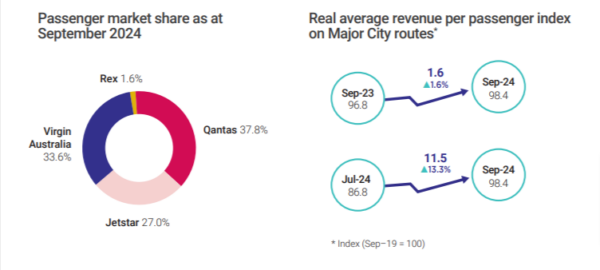
While it is an increase, Qantas and Jetstar also registered similar increases after a drop at the start of the year. That gives Qantas Group a substantial advantage that sandwiches Virgin Australia’s offering.
The proposed Qatar deal could help that, of course, offering Australians more options through Virgin Australia to connect international legs seamlessly to domestic legs.
But here is the elephant in the room. Qantas has recently been through some of the worst consumer ratings in its history. According to Roy Morgan, it is now the second most distrusted brand in Australia.
Last year Roy Morgan also named Virgin Australia as the Domestic Airline of the Year.
Despite this, its profits are still sky high, its share value is stronger than ever, and its planes are full. No one has been able to capitalise on the significant bad press.
But the other hurdle is Qantas Frequent Flyer – that old chestnut. Because when it comes to business, it is clear Australians are willing to take more than a slap in the face with a wet fish before they will shift away from their QFF membership.
Politicians will happily pay more for the wet slap as well, the SMH wrote recently.
“Flying in the face of the policy, more than 90 per cent of the nearly $30 million spent by MPs and their staff on travel last year went to Qantas and its subsidiary Jetstar, according to the Independent Parliamentary Expenses Authority.”
This is despite the fact that, according to the ACCC, Qantas led the pack when it came to cancelled flights in Sep this year and generally leads it.
Scale is one thing, IPOs another – but one of the biggest hurdles VA will face is a habitual one for one of the largest cohorts in the country – corporate Australia.
In Jayne Hrdlicka, Virgin Australia has exactly what it needs in a CEO – single-minded focus on a massive job ahead. Bit by bit, she is rebuilding from the ground up with Virgin Australia now poised to become a genuine threat in a market.
Bain Capital must be hoping that she stays a while longer – judging by the determination and the moving target, it might get its wish and the final flight for Hrdlicka could be ultra-long haul.
